
Entresto: When Clinical Strength Was Not Enough
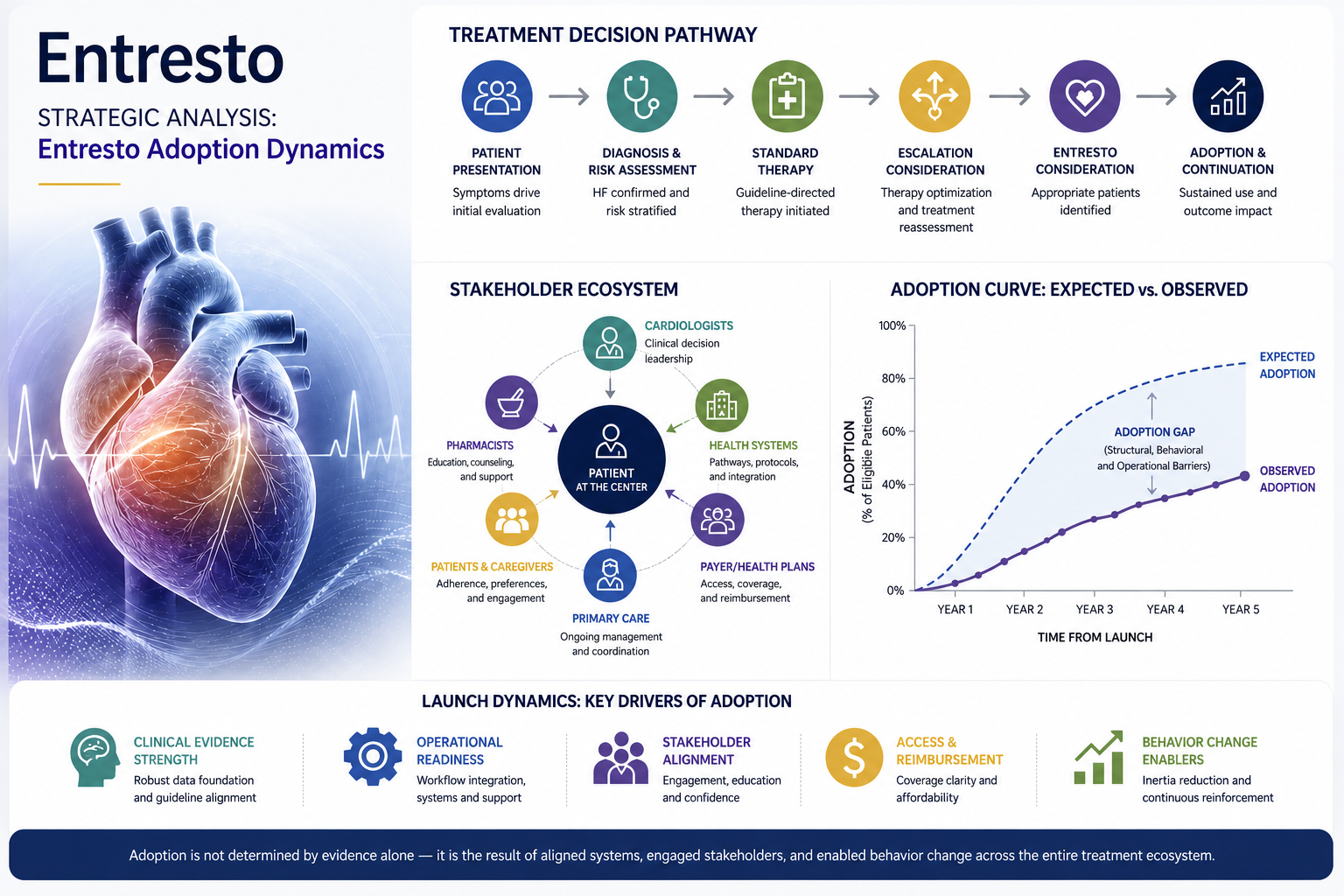
Entresto entered the market with significant clinical promise and the potential to reshape heart failure management. Supported by the PARADIGM-HF trial and reinforced through evolving treatment guidelines, the therapy was widely recognized as a major advancement in cardiovascular care. Yet heart failure represented one of the most structurally complex therapeutic environments in healthcare. Prescribing behavior was deeply entrenched, treatment pathways were fragmented across stakeholders, and adoption depended on coordinated alignment among cardiologists, health systems, payers, and primary care teams.
At launch, the prevailing assumption across much of the market was straightforward:
- Strong clinical evidence would naturally translate into rapid adoption.
- The real-world trajectory proved substantially more complex.
Gap
Entresto’s trajectory exposed a broader launch reality:
Strong evidence alone does not overcome structural adoption friction.
Despite compelling clinical data and broad therapeutic relevance, early adoption progressed more gradually than many expected. The challenge was not awareness. Physicians understood the evidence.
The challenge was that the broader system was not yet operationally prepared to translate evidence into widespread prescribing behavior.
Several interconnected barriers emerged simultaneously across the treatment ecosystem:
- Entrenched prescribing habits
- Workflow complexity
- Institutional inertia
- Reimbursement uncertainty
- Uneven stakeholder readiness
- Delayed integration into treatment pathways
- Competitive framing already established earlier in the decision journey
Rather than operating independently, these barriers reinforced one another. Adoption friction accumulated across clinical, operational, behavioral, and organizational dimensions, slowing the pace of real-world uptake despite strong scientific validation.
The result was a measurable gap between expected adoption curves and observed market behavior.
Insight
Using the Cognisus Cognitive Decision Framework™, the Entresto analysis highlighted a broader commercialization principle:
Adoption follows market readiness — not evidence alone.
The analysis demonstrated that launch trajectory is often determined long before launch itself, as stakeholder expectations, workflow norms, reimbursement assumptions, and prescribing behaviors become progressively embedded across the market.
Several strategic insights emerged:
Market conditioning begins earlier than most organizations realize
By the time many therapies reach approval, critical decision pathways may already be partially established. Disease framing, stakeholder education, institutional preparedness, and treatment expectations are often shaped years before launch.
Clinical superiority does not automatically change physician behavior
Even highly differentiated therapies must overcome operational realities, treatment habits, organizational protocols, and confidence thresholds before prescribing behavior changes consistently at scale.
Adoption barriers are cumulative
Clinical inertia, workflow burden, payer friction, and delayed pathway integration compounded one another. Adoption accelerated only as multiple reinforcing drivers aligned simultaneously across stakeholders.
Early positioning materially influences long-term trajectory
Entresto entered portions of the treatment journey after many prescribing assumptions and therapeutic expectations were already established. This reinforced how early decision influence can shape downstream adoption dynamics.
Implication
The Entresto experience provides a broader blueprint for understanding launch performance across specialty-care markets.
For emerging biopharma organizations, the case highlights several critical realities:
- Launch day does not create trajectory — it reveals it
- Market readiness must be intentionally engineered
- Awareness alone rarely changes prescribing behavior
- Structural friction compounds rapidly when left unaddressed
- Early commercial architecture influences long-term adoption velocity
The implications extend far beyond cardiovascular disease.
Across specialty launches, organizations that align clinical evidence with stakeholder readiness, decision architecture, market conditioning, and visibility infrastructure earlier in development are better positioned to accelerate adoption and reduce launch risk.
How Cognisus Applies These Insights
Cognisus helps emerging biopharma organizations identify hidden adoption barriers before launch through integrated launch architecture, stakeholder readiness analysis, decision pathway mapping, market conditioning strategies, and commercialization sequencing designed to improve early trajectory performance.
Rather than treating launch as a discrete event, Cognisus approaches commercialization as a coordinated system requiring alignment across evidence, behavior, infrastructure, stakeholder influence, and execution discipline.
“Launch failure is rarely caused by weak science. More often, the market was never structurally prepared for adoption.”
Selected Sources
- McMurray JJV, et al. Angiotensin–Neprilysin Inhibition versus Enalapril in Heart Failure. N Engl J Med. 2014.
- Yancy CW, et al. 2017 ACC/AHA/HFSA Focused Update of the Heart Failure Guidelines.
- IQVIA Institute. Launch Excellence Series.
- Publicly available guideline timelines, prescribing analyses, and market adoption data.
This analysis is based on publicly available information and is intended to illustrate broader commercialization and adoption dynamics. It does not represent proprietary client work or confidential commercial insight.