
Afrezza — Strategic Intervention
Executive Commercialization Context
Afrezza, an ultra-rapid-acting inhaled insulin approved by the FDA in June 2014, entered the diabetes marketplace with exceptionally high pre-launch expectations driven by its rapid pharmacokinetics, non-invasive administration profile, and the belief that millions of insulin-dependent patients would prefer inhalation over injection.¹ During the pre-launch commercialization period (2006–2011), substantial effort was directed toward identifying and addressing anticipated adoption barriers including reimbursement complexity, patient onboarding friction, packaging logistics, inhaler usability, and customer pathway integration. Many of these structural commercialization challenges continued to constrain adoption following launch despite Afrezza’s strong scientific differentiation.
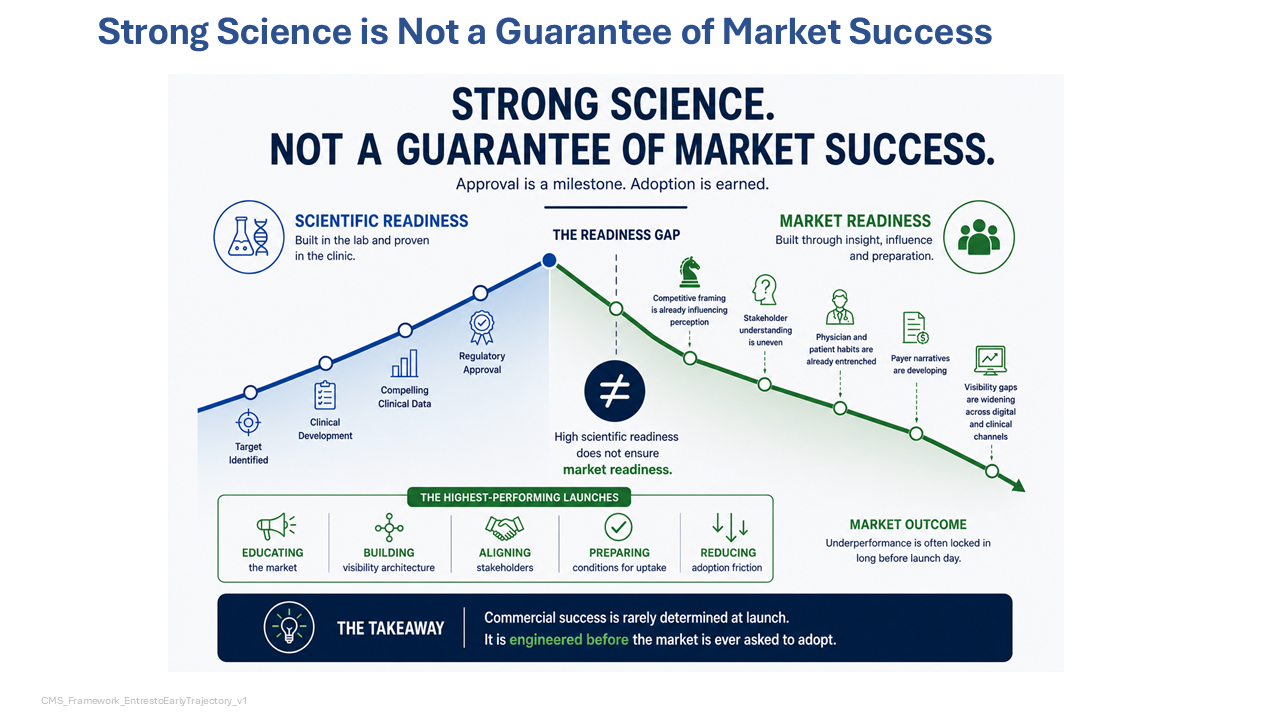
Commercialization Gap
1. Structural Skepticism Toward Inhaled Insulin
The commercial failure of Exubera created substantial skepticism toward inhaled insulin technologies, increasing the evidentiary and commercialization burden required to drive physician confidence, payer acceptance, and patient adoption.²
2. Complex Patient and Prescriber Pathway Friction
Spirometry requirements, dosing conversion complexity, onboarding requirements, reimbursement uncertainty, and multiple patient handoff points introduced significant opportunities for pathway leakage and delayed therapy initiation.³
3. Weak Commercialization Systems Integration
Packaging, manufacturing, reimbursement, distribution, medical, and commercial functions were not initially operating under fully aligned launch assumptions, creating downstream operational inefficiencies and launch friction.
4. Packaging and Distribution Constraints
Large refrigeration-dependent packaging created practical barriers for pharmacies and patients while increasing distribution complexity, storage burden, and downstream costs.
5. Positioning and Communication Complexity
Communicating inhaled insulin equivalency, pulmonary considerations, and dosing logic increased cognitive burden on both providers and patients, complicating market education efforts.
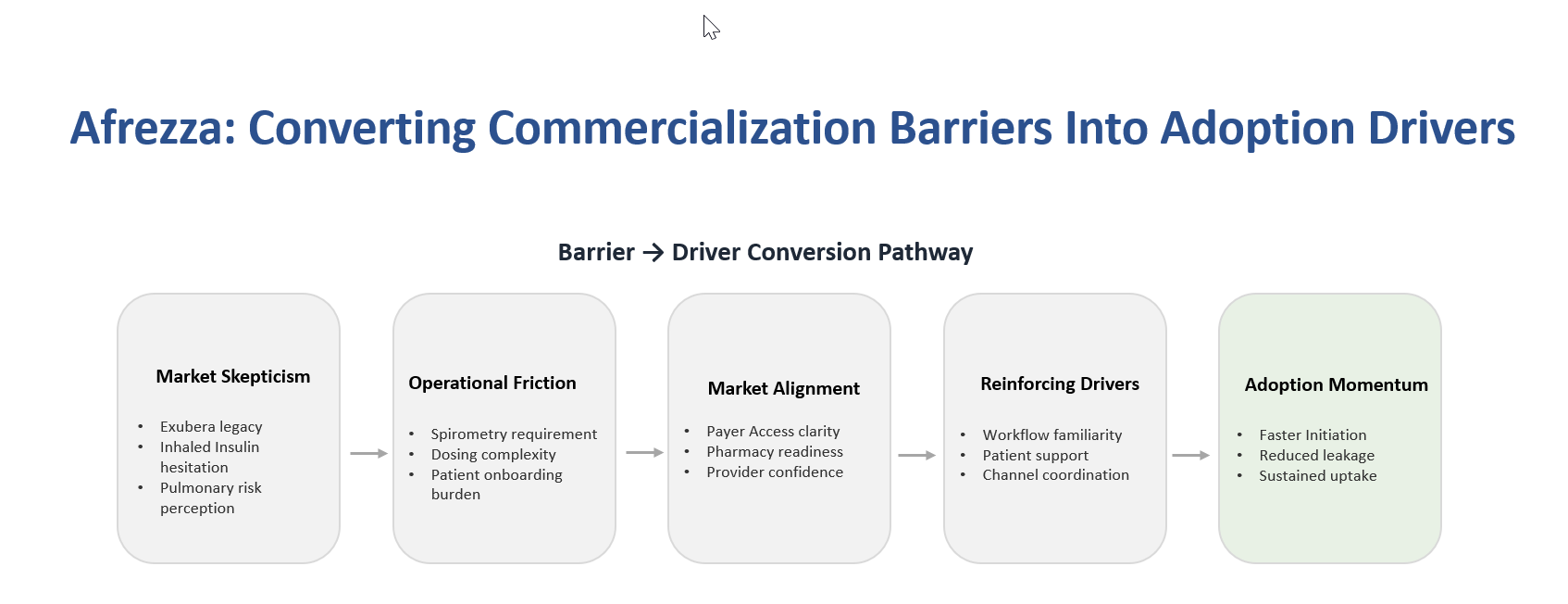
Strategic Intervention
- Established cross-functional commercial packaging team
- Extensive user inhaler and Directions for Use (DFU) usability research
- Channel/stakeholder research
- Packaging research
- Pricing and reimbursement strategy development
- Customer solutions framework creation
Observed Outcomes
- Packaging size reduced by 50%
- Device Redesign (Dreamboat)
- Improved HCP intent to prescribe
- Improved patient willingness to use
- Reduced delivery time and downstream costs
Adoption Dynamics Analysis
Afrezza demonstrated how strong scientific differentiation alone is insufficient to overcome deeply embedded market inertia, stakeholder skepticism, and commercialization pathway friction. Although the product addressed a meaningful unmet need through ultra-rapid pharmacokinetics and non-invasive administration, adoption required coordinated behavioral change across multiple stakeholders including physicians, patients, payers, pharmacies, educators, and distribution channels.
The launch environment reflected a classic “high-interest, high-friction” commercialization profile in which initial awareness substantially exceeded downstream adoption readiness. Significant pathway attrition occurred at multiple transition points including spirometry initiation, reimbursement approval, dosing understanding, pharmacy fulfillment, patient onboarding, and long-term therapy maintenance.
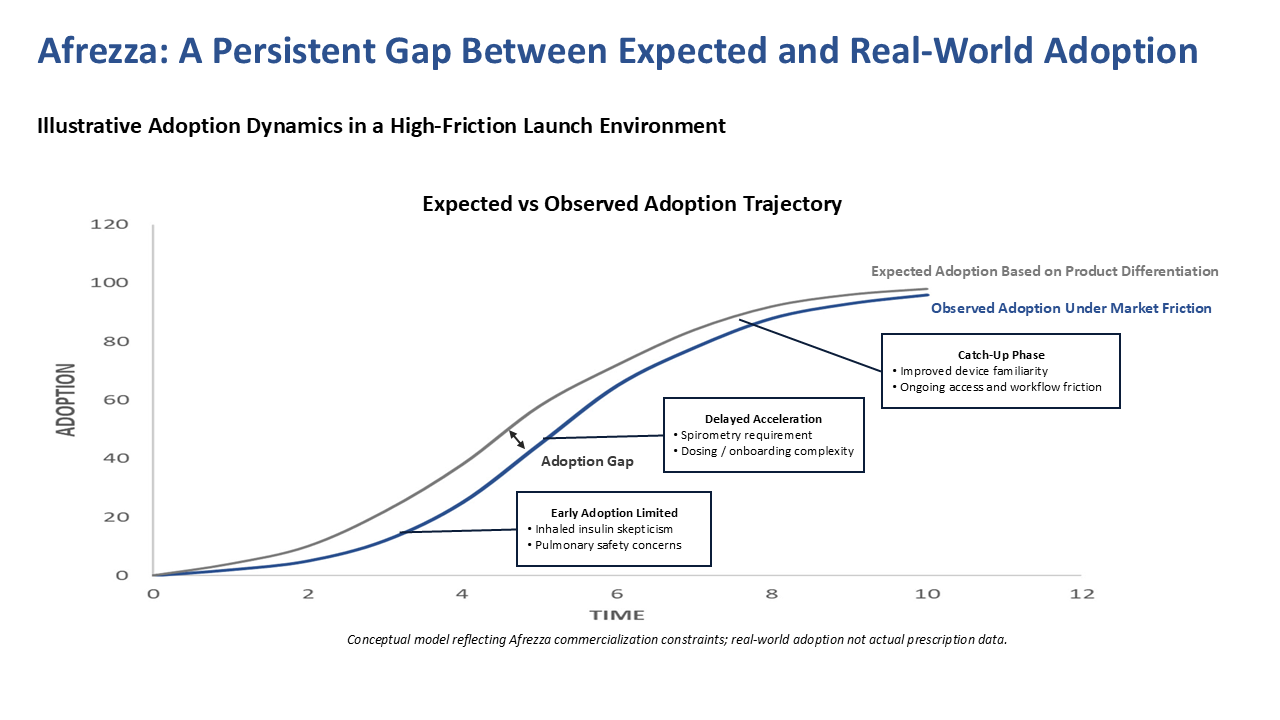
Importantly, many of the most significant adoption barriers were not product efficacy limitations, but commercialization systems challenges involving usability, education, workflow integration, reimbursement complexity, and ecosystem readiness. The launch reinforced the importance of minimizing cognitive burden, reducing pathway leakage, and aligning commercialization architecture well in advance of launch execution.
Decision Architecture Analysis
Afrezza highlighted the complexity of therapeutic adoption when multiple stakeholders must simultaneously modify entrenched behaviors, prescribing patterns, operational workflows, and reimbursement processes. Unlike traditional insulin therapies, successful adoption required alignment not only at the physician level, but across the broader commercialization ecosystem including payers, pharmacies, educators, caregivers, and patients.
Provider adoption was heavily influenced by the residual cognitive effects of Exubera’s commercial failure, creating elevated skepticism toward inhaled insulin technologies despite Afrezza’s substantially improved device profile and pharmacologic characteristics. Simultaneously, patient willingness to adopt was highly dependent upon simplified onboarding, dosing clarity, reimbursement transparency, and ease-of-use perceptions.
The commercialization challenge therefore extended beyond product awareness into decision architecture management — shaping how stakeholders evaluated risk, usability, convenience, clinical differentiation, and workflow disruption across the treatment pathway.
Structural Commercialization Implications
Afrezza reinforced that launch success is frequently constrained less by scientific differentiation than by the market’s operational readiness to absorb innovation. Products requiring changes in workflow, behavior, reimbursement processes, education, onboarding, or institutional coordination face substantially higher commercialization complexity than products fitting existing prescribing and fulfillment patterns.
The experience also demonstrated the importance of early commercialization systems integration. Packaging, reimbursement, training, patient support, distribution, and customer experience architecture cannot be developed independently without creating downstream friction that ultimately constrains adoption velocity.
Most importantly, Afrezza illustrated that commercialization readiness is established long before launch day. Once pathway friction becomes embedded within physician behavior, payer processes, pharmacy workflows, and patient expectations, later-stage remediation becomes substantially more difficult and expensive.
Cognisus Strategic Interpretation
From a Cognisus commercialization systems perspective, Afrezza represents a powerful example of how adoption must be engineered across the entire stakeholder ecosystem rather than assumed based on product innovation alone. The case illustrates that commercialization success depends upon reducing decision friction, aligning cross-functional readiness, simplifying pathway progression, and proactively shaping market expectations well before launch execution.
The broader implication for emerging biotech and pharmaceutical launches is that scientific innovation without integrated commercialization architecture frequently produces adoption underperformance despite strong clinical differentiation. Launch trajectory is heavily influenced by the quality of pre-launch market shaping, stakeholder orchestration, reimbursement readiness, workflow integration, and customer pathway design established prior to launch.
Afrezza ultimately reinforces a core Cognisus principle: commercial adoption is not an event occurring at launch — it is a structured decision process shaped progressively across the pre-launch commercialization window.
References (Vancouver Style)
- MannKind Corporation. MannKind Corporation Announces FDA Approval of AFREZZA®; A Novel, Rapid-Acting Inhaled Insulin for the Treatment of Diabetes [Internet]. Valencia (CA): MannKind Corporation; 2014 Jun 27 [cited 2026 May 19]. Available from: https://investors.mannkindcorp.com/news-releases/news-release-details/mannkind-corporation-announces-fda-approval-afrezzar-novel-rapid
- Inhalable insulin. Wikipedia [Internet]. [cited 2026 May 19]. Available from: https://en.wikipedia.org/wiki/Inhalable_insulin
- U.S. Food and Drug Administration. AFREZZA® (insulin human) Inhalation Powder Prescribing Information [Internet]. Silver Spring (MD): U.S. Food and Drug Administration; 2014 [cited 2026 May 19]. Available from: https://www.accessdata.fda.gov/drugsatfda_docs/label/2014/022472lbl.pdf